Plasma modeling is challenging for even the simplest cases (DC
and inductive discharges) due to the complex interaction between the
charged particles, neutrals and fields which collectively constitute
the plasma. Wave heated discharges add an extra layer of complexity,
due to the critical plasma density and capacitively coupled plasmas
require a special discretization scheme unique to COMSOL
Multiphysics. Equilibrium discharges avoid a lot of the complexity
the non-equilibrium cases, but are only valid under certain
conditions and present their own unique challenges.
Plasma Reactor Design and Optimization with Neural Network Inference
PhysAI can develop interactive plasma reactor tools powered by pre-trained neural network surrogate models. Once trained on high-fidelity COMSOL plasma simulations, the network runs entirely through inference—no solver calls required during exploration or optimization. The simple demo example below illustrates the concept; it is not a full production design environment, but shows what is possible with this approach.
Real-time exploration: Adjust physics and geometry settings by dragging sliders and see plasma fields update instantly.
Millisecond optimization: Optimize reactor geometry and operating pressure at a given power level in milliseconds using inference-only optimization.
License-free deployment: The app can be compiled to a standalone executable that anyone can run without a COMSOL license—end users need only the pre-trained network at runtime.
Pre-trained surrogate: The neural network learns the mapping between design parameters and plasma response, enabling rapid design iteration without repeated full simulations.
Simple demo example:This recording shows a representative plasma reactor app—not a full design tool. The same workflow can be packaged as a license-free executable so engineers, product managers, or customers can explore designs interactively without COMSOL or simulation expertise.
Capacitively Coupled Plasmas (CCPs)
Theoretical Foundations
CCPs rely on an electric field between parallel electrodes,
driven by RF power (typically 13.56 MHz). The sheath dynamics are
critical, modeled by the Poisson equation:
where \( \phi \) is the electric potential, and \( n_i \) and
\( n_e \) are ion and electron densities. The ion flux to the
substrate is governed by the Bohm criterion:
\[ u_i \geq \sqrt{\frac{k_B T_e}{m_i}} \]
where \( u_i \) is the ion velocity, \( k_B \) is Boltzmann’s
constant, and \( m_i \) is the ion mass. COMSOL simulates these
interactions, optimizing electrode design and gas pressure.
Applications
Semiconductor Industry: CCPs dominate plasma
etching (e.g., \( SF_6 \) for silicon) and sputtering for thin-film
deposition. Their precise control over ion energy ensures
high-aspect-ratio etching, vital for advanced semiconductor nodes.
They also neutralize toxic gases like \( NF_3 \).
Other Fields:
Medical Sterilization: CCPs generate
low-temperature plasmas for sterilizing heat-sensitive devices.
Clean Energy: They support plasma-assisted
catalysis for CO₂ reduction.
Non-Visible Light Sources: CCPs drive neon
or argon-based glow discharges for UV and IR applications.
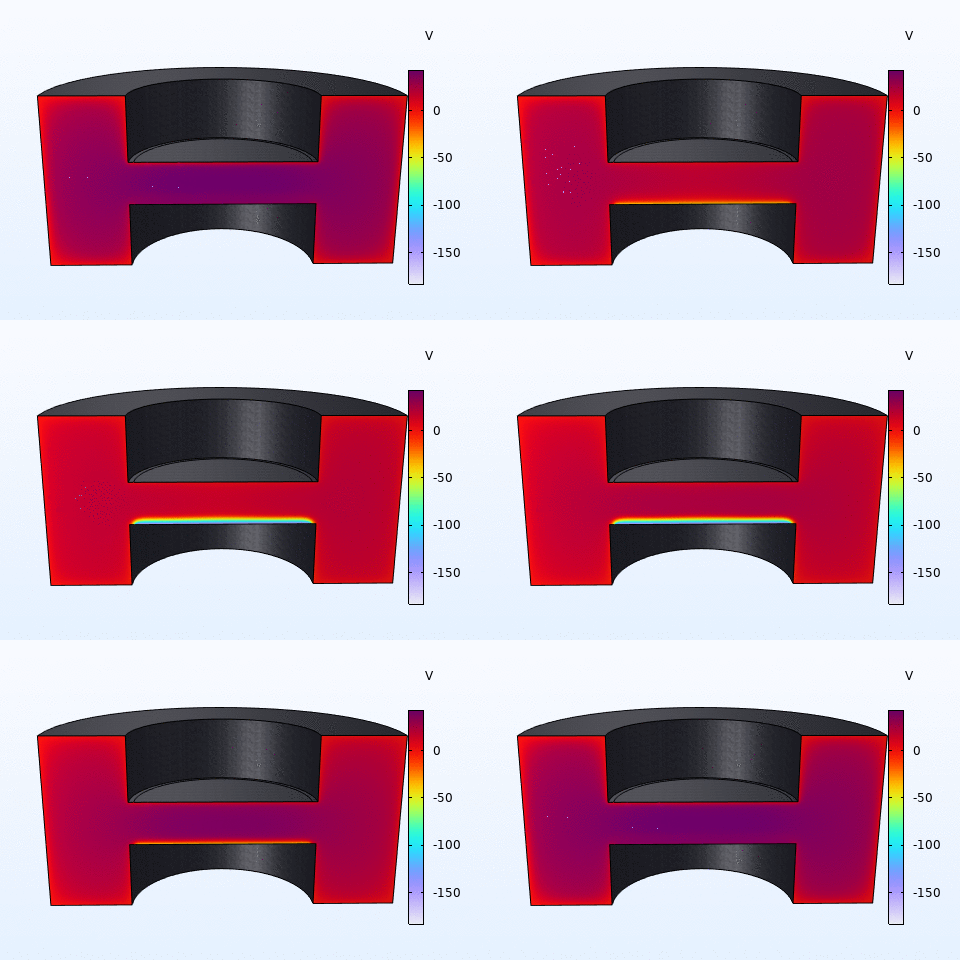
Electric Potential:The electric potential
oscillates at 13.56MHz, and naturally forms a negative DC bias on
the lower, driven electrode. This occurs because the surface area of
the driven electrode is much smaller than the containing grounded
walls.
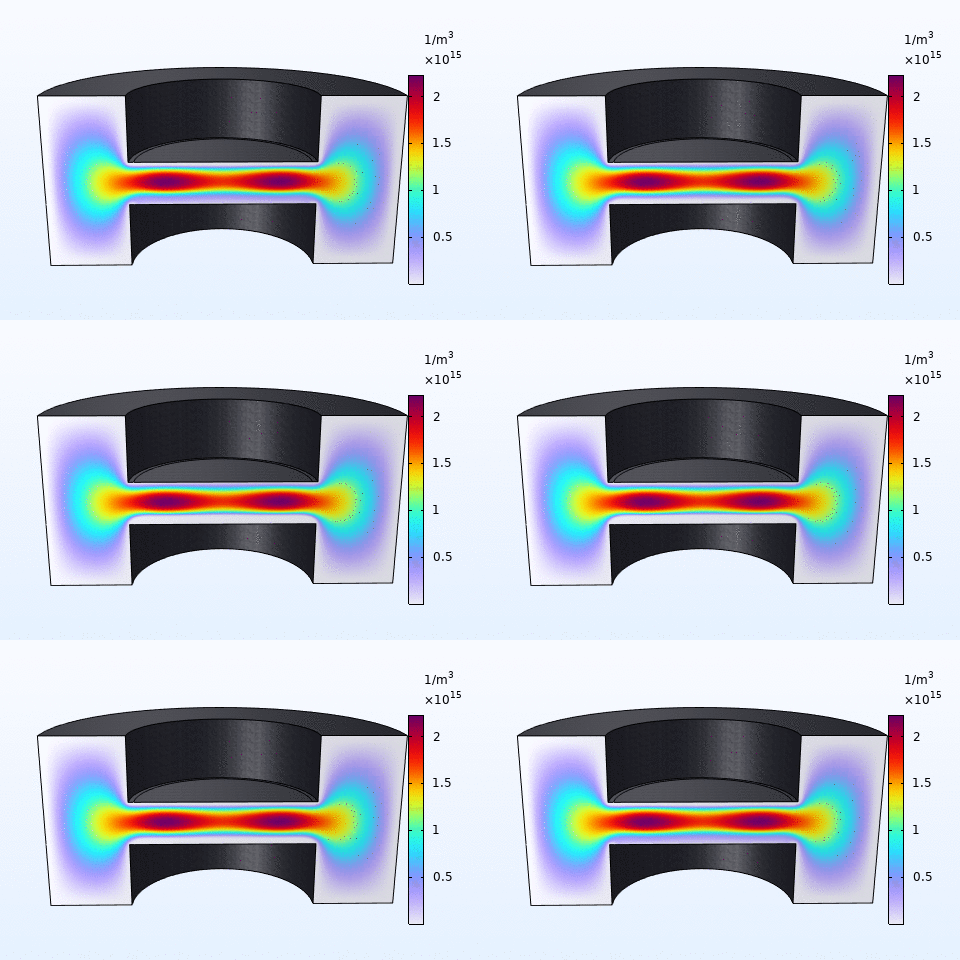
Electron Density:The electron density
oscillates in the plasma sheath region close to the grounded top
electrode and driven electrode on the base.
Microwave Plasmas
Theoretical Foundations
Microwave plasmas are sustained by electromagnetic waves,
typically at 2.45 GHz, interacting with gas molecules. The wave
propagation is described by the vector Helmholtz equation and plasma
permittivity \( \epsilon_p \) given by:
Here, \( \omega_p = \sqrt{n_e e^2 / (m_e \epsilon_0)} \) is the
plasma frequency, and \( \nu \) is the collision frequency. COMSOL
models these dynamics, capturing the transition from microwave
absorption to plasma ignition.
Applications
Semiconductor Industry: Microwave plasmas enable
high-rate deposition of diamond-like carbon (DLC) films, used as
protective coatings in chip manufacturing. Their ability to operate
at low pressures enhances control over reactive gas generation (e.g.,
\( CH_4 \)-based radicals).
Other Fields:
Medical Sterilization: High-density
microwave plasmas sterilize surfaces via UV emission and radical
production.
Clean Energy: They drive hydrogen
production via methane reforming, a step toward sustainable fuels.
Non-Visible Light Sources: Microwave
plasmas power excimer lamps, emitting UV for photolithography.
Inductively Coupled Plasmas (ICPs)
Theoretical Foundations
ICPs are generated by an oscillating magnetic field from a
coil, inducing electric currents in the plasma. The power transfer is
governed by Faraday’s law and Maxwell’s equations, with the induced
electric field \( E \) satisfying:
Semiconductor Industry: ICPs excel in plasma etching
and deposition for microchip fabrication. Their high electron density
(up to \( 10^{18} \, \text{m}^{-3} \)) ensures uniform reactive ion
etching (RIE) of silicon wafers, critical for nanoscale features.
They also generate reactive gases (e.g., \( CF_4 \)) and destroy
toxic byproducts like perfluorocarbons.
Other Fields:
Medical Sterilization: ICPs produce
reactive oxygen and nitrogen species (ROS/RNS) to sterilize
equipment without heat damage.
Clean Energy: They facilitate
plasma-enhanced chemical vapor deposition (PECVD) for solar cell
production.
Non-Visible Light Sources: ICPs power UV
lamps for water purification.